
About us
A clinic built around explanation
Every fertility journey carries its own emotional, physical and medical weight. We believe patients deserve clear explanations, honest expectations, and care shaped around their own biological parameters rather than a standard protocol.
Our approach
Compassionate science, plainly explained
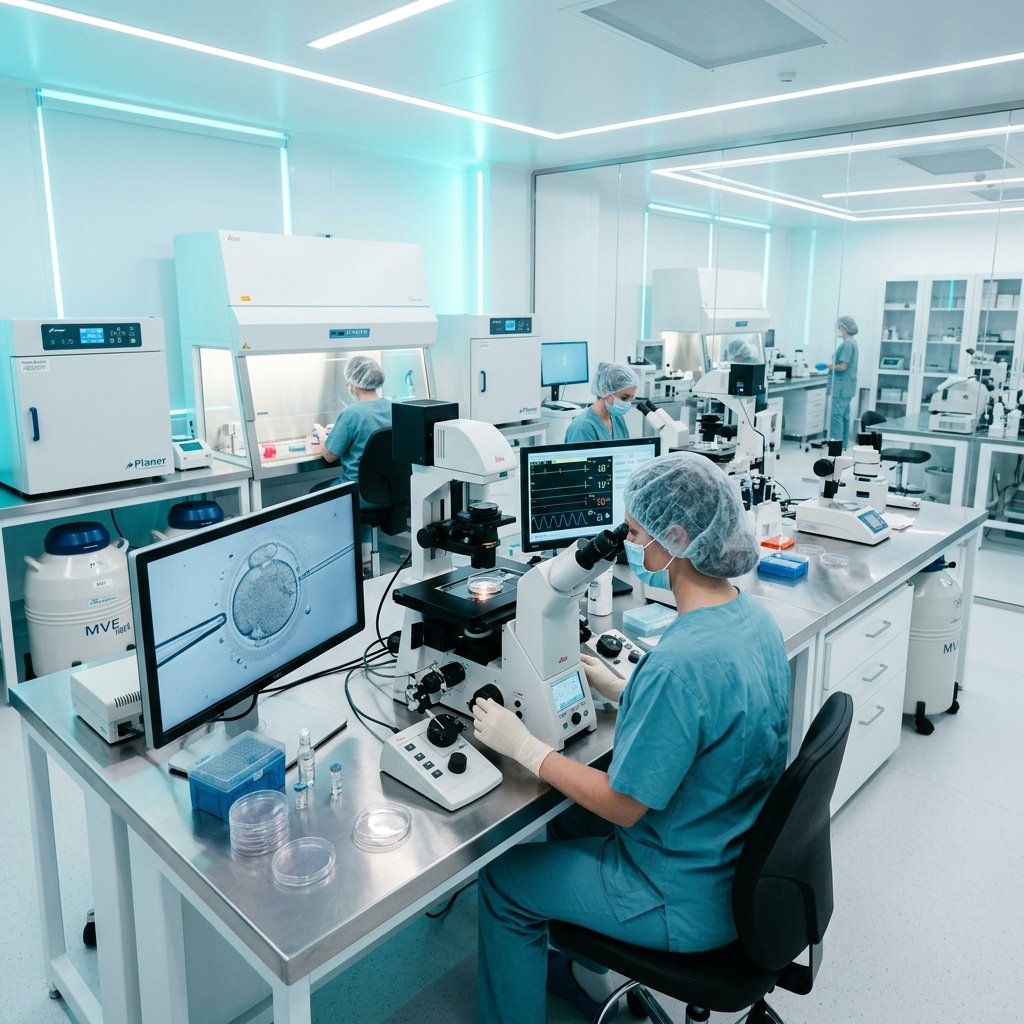
Our facility is built with dedicated air-handling units using HEPA filtration, climate-controlled culture suites, and high-magnification micromanipulators, to provide a stable environment for egg and embryo development.
What that means for you in practice is simpler: results are explained in terms you can actually use when making a decision, and you are told what is still unknown as readily as what is known.
What we hold ourselves to
The pillars of the centre
Mission
To deliver evidence-based reproductive care with integrity, transparency and personal compassion for every patient.
Vision
To be a trusted place of hope, where families feel genuinely informed by clinical expertise and treated with dignity.
Patient-first care
Your questions, your choices and your psychological comfort stay central to every diagnostic and therapeutic recommendation.
International scientific heritage
Pioneered by Dr. Suresh Kattera and ASPIER
With more than 30 years of clinical embryology and reproductive medicine experience across Singapore, the United States, the United Kingdom, Belgium and Italy, Dr. Suresh Kattera founded ASPIER to raise embryological standards and train specialists across Asia.
2001
Short co-incubation in IVF
An early advocate of short co-incubation, published in Fertility & Sterility, reducing free-radical exposure during fertilisation.
2003
Tri-pronuclear enucleation
First reported live birth following microsurgical enucleation of tri-pronuclear zygotes, published in Human Reproduction.
2003
Early rescue ICSI
First reported live births from early rescue ICSI of IVF-failed oocytes, published in Human Reproduction.
2005
Foundations of the freeze-all strategy
Early evidence that frozen embryo transfer can offer better uterine receptivity and implantation than fresh cycles.
Embryology transparency
What “Day 5, 4AA” actually means
Embryos are graded on three things: how far the blastocyst has expanded (1 to 6), the quality of the inner cell mass which becomes the baby (A to C), and the trophectoderm which becomes the placenta (A to C). So “4AA” describes an expanded blastocyst with tightly packed, cohesive cells in both layers.
We tell patients their grades and explain what they do and do not predict. A grade is a snapshot of appearance at one moment, not a verdict.
Read about blastocyst cultureNext step
Begin with clear answers and an honest consultation
Bring whatever reports you already have. We will tell you what they show, what is still unknown, and what a reasonable next step looks like — with no obligation to start treatment.